Month-end billing, one clear step at a time.
Set your rates once. Each month, WaterWorksPro walks you from readings to bills in six steps, checks for problems along the way, and won't let a questionable reading slip onto a bill.
- Tiered water and sewer
- Late fees on autopilot
- Print or email bills
Your rate ordinance, set up without a consultant.
A five-step rate wizard asks the questions in plain words: which service, flat or tiered, what billing unit, which rates. Before you save, it shows a sample bill so you can check the math against your ordinance.
- Tiered or flat water rates, with base charges
- Sewer as an add-on to water, as a flat fee or a percentage
- Base-charge-only schedules for flat-rate customers
- An advanced editor when you need to fine-tune
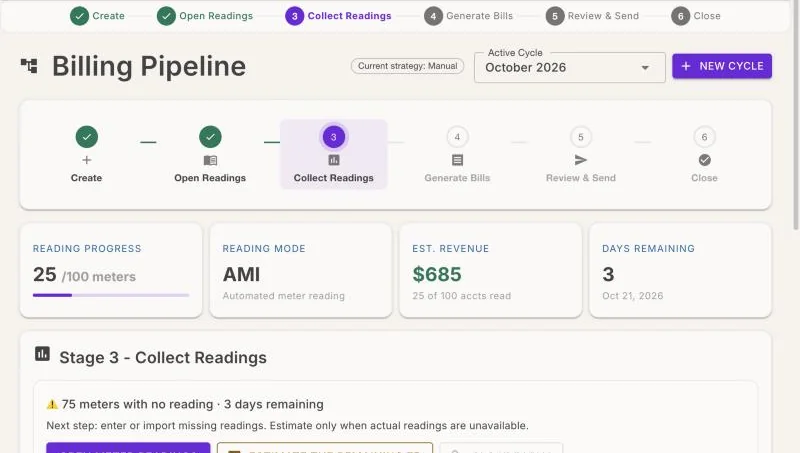
The same six steps every month: create, read, collect, generate, send, close.
The Billing Pipeline shows where the month stands and what to do next. It counts which meters are read, offers to estimate the rest from usage history, and holds bill generation until every flagged reading has been looked at.
- Estimates use each meter's history, and a meter with no history is never guessed
- Readings that look wrong are flagged before they reach a bill
- Preview bills before anything goes out
Print them, email them, or both.
Send bills by email, or print them as PDFs in batches, including on postcard-style cardstock you design yourself. Late fees can be charged each night automatically, with your grace period and cap, or applied by hand when you choose.
- Email delivery and a print queue
- Late fees as a flat amount or a percentage, with a grace period and cap
- Every bill, fee and change is recorded in the audit log
Billing questions, answered.
Can it handle our rate structure?
Most small-town structures, yes: tiered or flat water, base charges, and sewer billed as a flat fee or a percentage of water. Send us your rate ordinance and we'll tell you plainly whether it fits.
What happens if a meter reading looks wrong?
It's flagged. Readings that drop, show no usage, or jump well above a meter's average are listed for a person to fix or approve, and bills can't be generated while a flag is still open.
How long does a billing cycle take?
The work that takes the time is getting readings in. Once they're in, generating, reviewing and sending bills is a few steps in the Billing Pipeline. Try a full month yourself in the five-minute demo.
Can we keep mailing paper bills?
Yes. Print bills as PDFs in batches, on regular paper or postcard cardstock, and email them to customers who prefer that.
Run a billing month yourself.
The live demo takes you from readings to a finished bill on a sample utility. No sign-up.